
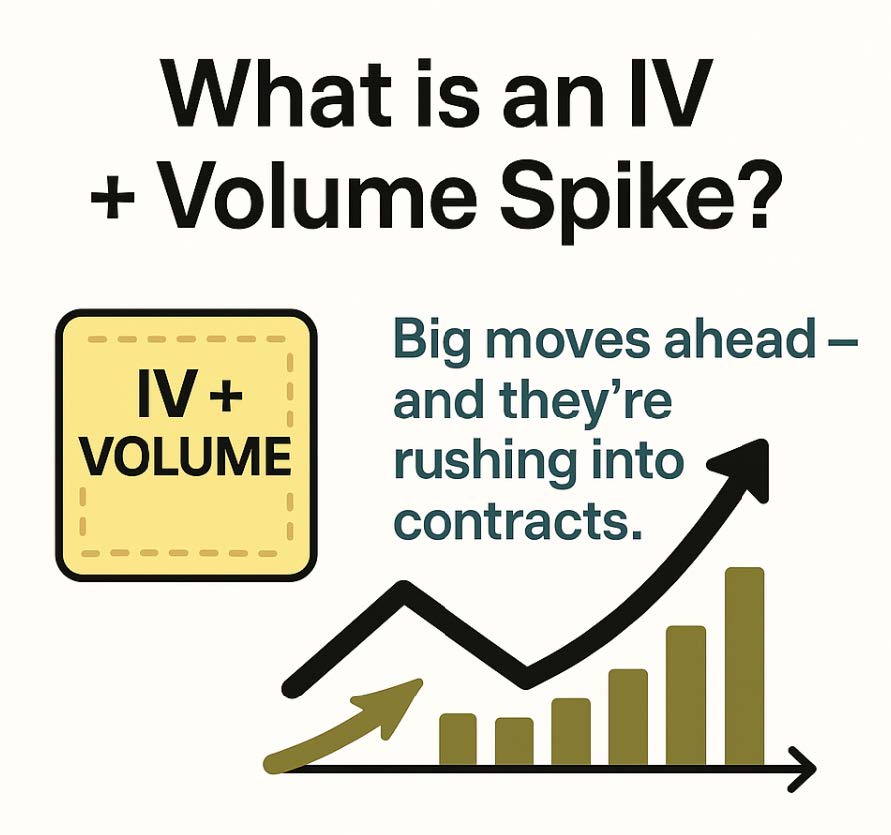
An IV + Volume Spike happens when:
● Implied Volatility (IV) suddenly increases, AND
● Option volume surges well above normal levels.
This combination often signals that traders are expecting big moves ahead — and they’re rushing into contracts.
Why do traders care?
● IV spike = fear or excitement. It reflects higher expected movement.
● Volume spike = unusual activity. More contracts trading than normal.
● Together = smoke and fire. Traders aren’t just nervous — they’re acting on it.
How to spot it (quick tells)
● IV chart shows a sudden upward jump.
● Option volume is several times higher than average.
● Volume often exceeds current Open Interest (OI).
● Big sweeps/blocks concentrated in near-term expiries.
Interpreting the intent
● Bullish case: Call volume spikes + rising IV → speculation on upside.
● Bearish case: Put volume spikes + rising IV → protection or downside bets.
● Event-driven: Before earnings, Fed announcements, or major news → traders bid up IV + volume.
Rules of thumb
● “IV without volume = empty hype. Volume without IV = routine churn. Both together = signal.”
● IV spikes before events = premium is expensive, beware IV crush after.
● Clustered spikes at certain strikes often highlight levels of interest.
● Direction matters. Check whether calls or puts dominate the spike.
Practical playbook
● Momentum trader: Follow IV+volume spikes that align with market trend.
● Contrarian trader: Fade overpriced IV after events when volume dries up.
● Risk-aware: Avoid chasing IV spikes blindly — premiums are inflated.
Quick checklist (IV + Volume Spike Scan)
● Did IV jump sharply?
● Is option volume unusually high vs average?
● Is volume > OI?
● Are spikes in calls, puts, or both?
● Is there a known catalyst ahead?